
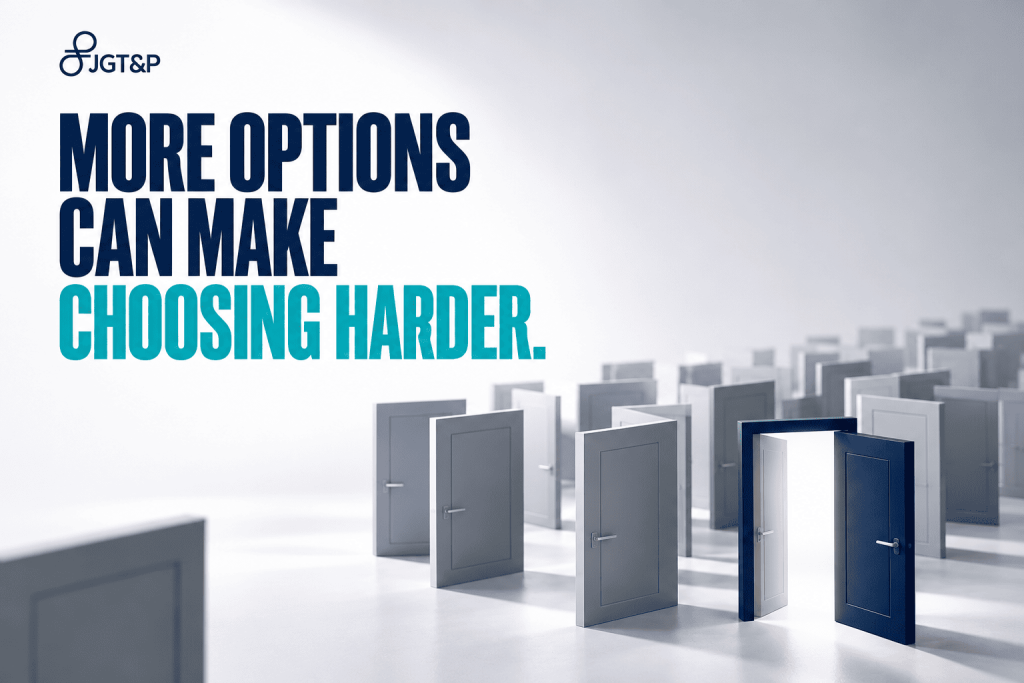
The paradox of choice explains why offering customers more options doesn’t always lead to better decisions. In marketing, what looks like greater freedom can sometimes create confusion, hesitation, and decision fatigue.
Imagine visiting a website to purchase a service. You find multiple packages, overlapping features, and different pricing options. Everything looks appealing, but the differences aren’t immediately clear.
Instead of making a confident decision, you start comparing, questioning, and reconsidering.
Eventually, you leave without choosing anything.
This is where businesses face an important challenge: offering variety can attract customers, but too many poorly organized options can make choosing unnecessarily difficult.
The goal isn’t simply to offer fewer choices. It’s to make the right choice easier to recognize.
What Is the Paradox of Choice?
The paradox of choice is the idea that having more options can sometimes make decision-making harder rather than more satisfying.
While choice gives customers flexibility and control, an excessive number of alternatives can increase the mental effort required to evaluate them.
This becomes particularly relevant when options are similar, information is complicated, or customers don’t have clear criteria for making comparisons.
In marketing, the paradox of choice helps explain why a business with an extensive product range may still struggle to guide customers toward a purchase.
The problem isn’t necessarily the number of products or services available.
It’s the effort required to understand the differences and decide which option provides the most relevant value.
How Choice Overload Affects Consumer Behavior
Choice overload occurs when the number or complexity of available alternatives makes choosing difficult.
Customers may experience several challenges:
- Decision fatigue: Comparing numerous alternatives requires sustained mental effort.
- Uncertainty: Similar-looking options can make it difficult to identify meaningful differences.
- Decision delay: Customers may postpone choosing because they feel they need more information.
- Second-guessing: Even after making a decision, customers may wonder whether another option would have been better.
However, more choice doesn’t always create these problems.
The impact depends on factors such as customer familiarity, the complexity of the decision, individual preferences, and how effectively the options are presented.
A wide selection can be valuable when customers know what they’re looking for and can navigate the available choices easily.
The real challenge is reducing unnecessary complexity without limiting meaningful choice.
Why More Options Don’t Always Mean Better Marketing
Businesses often expand their offerings with good intentions.
More products can serve different customer needs. More service packages can accommodate different budgets. More features can make a solution appear more competitive.
But additional options don’t automatically create additional value.
When businesses focus on the quantity of choices rather than the clarity of those choices, they risk making the customer journey more complicated.
When Every Option Looks Equally Important
Imagine a marketing agency offering eight service packages.
Each package includes a different combination of strategy, advertising, reporting, content, and consultancy.
But the package descriptions use similar language, and the differences aren’t clearly explained.
A potential customer may struggle to understand which package is appropriate for their business.
Now imagine the same agency organizing its services around three clear objectives:
- Build Your Foundation: For businesses that need strategic direction and a defined marketing plan.
- Accelerate Acquisition: For businesses focused on attracting customers and generating qualified leads.
- Optimize Performance: For businesses aiming to improve existing campaigns and marketing efficiency.
The underlying services may remain similar, but the way they’re presented makes the decision more manageable.
Customers can begin by identifying their own objectives rather than comparing every feature individually.
Too Many Options vs. Clear Choices: A Marketing Example
| Too Many Options | Clear, Structured Choices |
|---|---|
| Eight service packages with overlapping features | Three service categories organized by business goals |
| Similar descriptions that make comparison difficult | Clear explanations of who each service is for |
| Customers must evaluate every package individually | Customers can identify options relevant to their needs |
| Unclear differences between available services | Meaningful differences highlighted upfront |
| Greater effort required to make a decision | A more focused and guided decision-making experience |
The key isn’t necessarily reducing the number of services a business offers. It’s simplifying how those services are presented.
When customers understand their options, they’re better equipped to make confident decisions.
This is the difference between providing options and providing direction.
The Connection Between the Paradox of Choice and Customer Decision Making
Customers rarely evaluate products and services in isolation.
Their purchase decisions are influenced by their needs, expectations, available information, perceived risks, and the effort required to compare alternatives.
When a business makes its offering difficult to understand, customers must do more of that work themselves.
They need to identify important features, interpret differences, and determine which option best fits their situation.
This can introduce unnecessary friction into the buying process.
Clarity Reduces the Effort of Choosing
Clear product descriptions, relevant comparisons, and organized information help customers focus on what matters.
For example, an e-commerce business selling skincare products could organize its selection by skin concern rather than presenting every product in one large collection.
A software provider could group subscription plans by business requirements instead of highlighting long lists of technical features.
A consultancy could explain which services are most appropriate for different growth stages.
In each case, the business isn’t necessarily removing options.
It’s creating a clearer path toward a relevant decision.
And in competitive markets, a smoother decision-making experience can become a meaningful advantage.
How Brands Can Reduce Choice Overload in Marketing
Managing the paradox of choice requires more than reducing the number of products or packages.
It requires understanding how customers evaluate options and designing an experience that supports their decisions.
1. Organize Options Around Customer Needs
Customers are usually more interested in solving a problem than understanding how your internal offerings are structured.
Instead of presenting everything at once, group products or services according to recognizable needs, goals, or use cases.
For example, a digital marketing business could organize its offerings around objectives such as increasing visibility, generating leads, or improving campaign performance.
This helps customers identify a relevant starting point without reviewing every available service.
2. Highlight Meaningful Differences
When multiple options appear similar, customers may find it difficult to justify choosing one over another.
Clear differentiation makes comparisons easier.
Rather than relying on generic descriptions such as “premium quality” or “advanced features,” explain the practical differences between alternatives.
Consider highlighting:
- Who each option is designed for.
- The specific problem it addresses.
- Its most relevant features or benefits.
- When it may be more suitable than another option.
- The trade-offs customers should understand.
The objective is to make differences useful, not simply visible.
3. Create a Clear Information Hierarchy
Not every detail needs equal prominence.
Customers should be able to understand the most important information before exploring additional specifications.
Start with the core value of each offering.
Then introduce supporting details, comparisons, and technical information where they become relevant.
This approach creates a more manageable experience without withholding information customers may need.
A clear information hierarchy is especially important on landing pages, product pages, and service comparison sections where customers are expected to take action.
4. Use Guided Recommendations
Sometimes customers need help identifying which option fits their needs.
Guided recommendations can simplify this process.
A few relevant questions, a product selector, or a comparison tool can help narrow the available choices based on customer priorities.
For example, a software company might ask about team size, primary business goals, and required functionality before suggesting a subscription plan.
Recommendations should be transparent and based on meaningful criteria.
Their role is to support the customer’s decision, not pressure them toward an unsuitable option.
5. Make the Next Step Obvious
Even when customers understand their options, unclear calls to action can create another barrier.
A page offering too many competing actions may leave visitors uncertain about what to do next.
Instead, define the most relevant action for each stage of the customer journey.
That might be:
- Compare available plans.
- Explore product details.
- Request a consultation.
- Start a free trial.
- Complete a purchase.
The right call to action depends on the customer’s readiness and the complexity of the decision.
A clear next step helps turn understanding into action.
How Choice Architecture Can Improve Marketing Performance
Choice architecture refers to how options are organized and presented to influence the decision-making environment.
In marketing, this includes everything from product categories and pricing tables to website navigation and campaign messaging.
Effective choice architecture doesn’t require eliminating customer freedom.
It means designing an experience in which information is accessible, comparisons are meaningful, and decisions are easier to evaluate.
For businesses, this can support several important marketing objectives.
A clearer customer journey: Visitors can move from identifying their needs to exploring relevant options with fewer unnecessary obstacles.
More effective communication: Brands can emphasize the benefits and differences that matter most to their audiences.
Better-qualified inquiries: Customers who understand the available services may be better prepared to discuss their requirements.
Potential improvements in conversion performance: Reducing unnecessary friction can help customers progress toward meaningful actions, although results should be tested rather than assumed.
The goal is not to make every decision effortless.
It is to remove the complexity that doesn’t help customers make a better choice.
How to Measure Whether Your Choices Are Helping or Hurting Conversions
Simplifying options should be a strategic decision supported by evidence.
Before removing products, changing service packages, or redesigning pricing pages, businesses should examine how customers currently interact with their offerings.
Useful indicators include:
Conversion Rate
Are visitors completing the actions the business wants them to take?
Comparing conversion rates before and after changes can provide useful direction, especially when other important variables are controlled.
Product or Plan Selection Patterns
Do customers consistently choose certain options while ignoring others?
This may reveal differences in demand, unclear positioning, or problems with how alternatives are communicated.
Funnel Drop-Off
Where do potential customers leave the buying process?
High drop-off on a comparison or pricing page can indicate friction worth investigating, although it doesn’t prove choice overload is the cause.
Customer Feedback
What questions do customers repeatedly ask before purchasing?
If visitors frequently struggle to understand differences between products or packages, the information architecture may need improvement.
A/B Testing
Testing different presentation formats can help businesses evaluate whether changes improve outcomes.
For example, a company could compare a feature-heavy pricing page with a version that prioritizes customer needs and recommended use cases.
The strongest approach is to combine behavioral data and performance analysis with customer insights rather than assuming that fewer options will automatically produce better results.
Finding the Right Balance Between Variety and Simplicity
The paradox of choice doesn’t mean that businesses should limit every customer to two or three alternatives.
Different audiences have different needs.
Experienced customers may appreciate extensive options and detailed comparisons. First-time buyers may benefit from clearer guidance and fewer decisions at each stage.
The right balance depends on the product category, customer expectations, and complexity of the purchase.
A useful principle is to offer meaningful variety while reducing unnecessary decision-making effort.
Businesses can achieve this by making options easy to discover, differences easy to compare, and recommendations relevant to individual needs.
Good marketing isn’t about controlling what customers choose.
It’s about giving them the clarity and confidence to choose what works for them.
Better Decisions Create Better Opportunities for Growth
More options don’t automatically mean more value.
Sometimes, the strongest customer experience comes from knowing what to simplify, what to highlight, and what to explain.
The paradox of choice reminds businesses that every additional product, feature, or message should serve a clear purpose.
When brands organize their offerings around customer needs, communicate meaningful differences, and make decisions easier to navigate, they create a stronger foundation for customer engagement and marketing performance.
At JGT&P, we believe effective marketing starts with understanding how people think, evaluate, and make decisions. Through our Strategy & Consultancy and Performance Marketing services, we help businesses connect audience insights, clear communication, and measurable performance with their growth objectives.
Because growth isn’t only about giving customers more options.
It’s about helping them recognize the right one.
Ready to Make Customer Decisions Easier and Marketing More Effective?
Clearer choices start with better strategic thinking. If you want to simplify your customer journey, communicate meaningful differences, and improve marketing performance, JGT&P can help you turn complexity into a more focused path to growth.
Start the Conversation With JGT&P →
Your Growth Companion.